

Turkey has generated 895 billion kilowatt hours (kWh) of electricity from 587 hydroelectric power plants put into service in the last 18 years, contributing 233 billion TL ($33.3 billion) to the economy.
 Minister Bekir Pakdemirli said that hydroelectric power is the backbone of electricity production in Turkey and that the State Hydraulic Works (DSI) has completed important projects to achieve this. He added that DSI and private sector companies have accelerated their work by providing the private sector with the opportunity to invest in this area.
As the country aims to take advantage of domestic and renewable energy sources to reduce the share of imports, the country's production potential has increased from 44 billion kWh to 102.1 billion kWh.
Turkey's renewable energy capacity increased significantly in 2019, a steady increase of 11% year-on-year.
Pakdemirli stated that the potential of the country to use water resources is still behind and they will continue to contribute to the effective use of the projects. He noted that hydroelectric power plants are crucial to meet Turkey's rapidly growing energy demand in a timely, clean and renewable way.
The great Tigris dam will soon operate
Meanwhile, the country will soon begin operating its first turbine at the Ilisu Dam on the Tigris River in Mardin, southeastern Turkey.
Erdogan said that on May 19, we will start using one of the six turbines in the Ilısu Dam, one of the largest irrigation and energy projects in our country. The dam is expected to generate 4.1 billion kilowatt hours of electricity per year and contribute 2 billion TL annually to the Turkish economy. Ilısu, a project that accelerates the development in the region within the framework of the Southeastern Anatolia Project (GAP), is the second largest dam in Turkey after the Atatürk Dam, whose reservoir has a water capacity of 48 billion cubic meters. It was completed in 1992.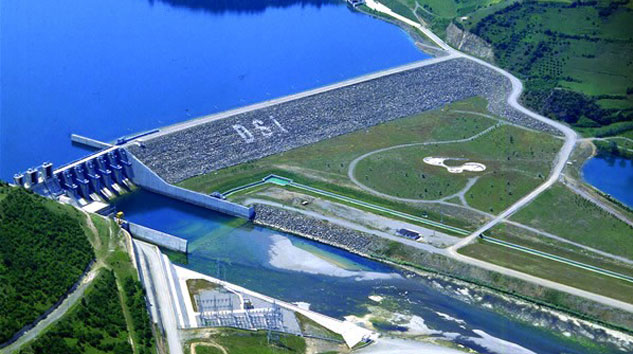
Ilısu Dam saw an estimated investment cost of 12 billion TL.
Mega plants
Turkey had begun building dams on the Euphrates within the framework of the $32 billion GAP launched in 1977, one of the world's largest and most comprehensive sustainable development projects involving efficient irrigation methods and a water infrastructure development program.
Energy generated at the Atatürk, Karakaya and Keban dams, Turkey's three largest hydroelectric power plants, increased by 106% in 2019 compared to the previous year, and the three dams have contributed over TL 400 billion to the Turkish economy since their opening. According to DSI data.
According to 2019 data, Atatürk Dam has contributed more than 150 billion TL to the Turkish economy for 26 years.
The dam, which ranks fifth in the world in terms of dam body, is the largest hydroelectric dam in both Turkey and Europe, contributing to the local economy and food supply with fish farms.
Turkey's second largest hydroelectric power plant, Karakaya, was built on the Euphrates in the Çüngüş district of Diyarbakır and started to produce electricity in 1987. With a generation capacity of 6.66 billion kWh, the dam provides electricity to 2.11 million households. Since its opening, the Karakaya Dam has generated 93.8 billion TL for the economy.
The third largest hydroelectric power plant, the Keban Dam, was built in 1974 and is also located on the Euphrates but in Elazığ Keban. On average, the dam produces 5.79 billion kWh of energy, enough to provide electricity to 1.83 million households. Its economic contribution of more than 45 years was calculated as TL 157.3 billion.
 SİZİN DÜŞÜNCELERİNİZ?

